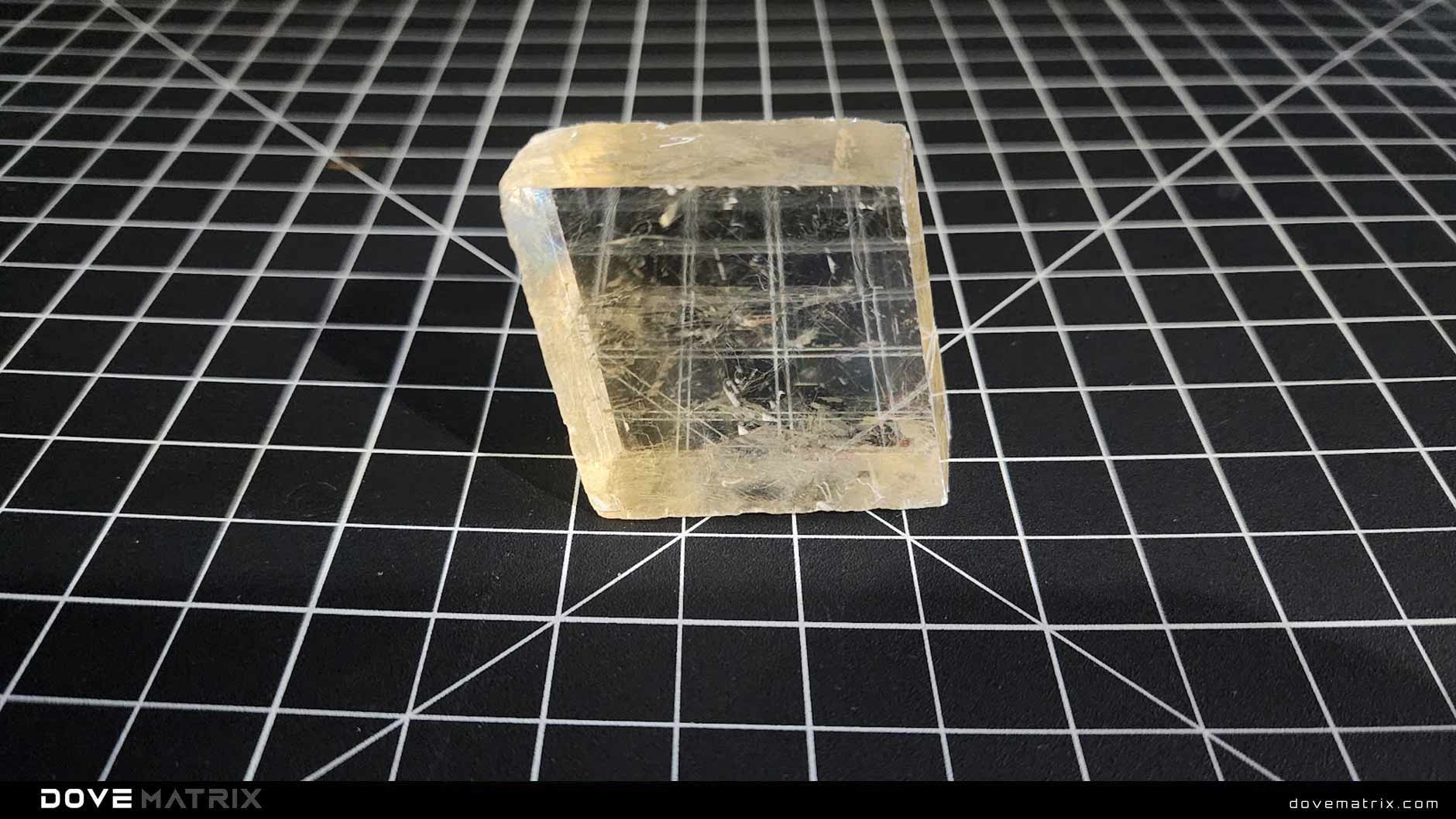
SPECIMEN ID
023-CaCO₃
MATERIAL CLASS
Crystalline Mineral
STATUS
Under Evaluation
DOMAIN
Optical Materials
Analysis
Specimen 023-CaCO₃ Incident
Transparent crystalline body transmits incident light while producing pronounced double refraction (birefringence). A single incident ray entering the crystal splits into two distinct internally refracted rays traveling at different velocities and angles. Visual objects viewed through the specimen appear doubled with angular separation proportional to crystal thickness.
Specimen 023-CaCO₃ Structure
Crystal exhibits characteristic rhombohedral cleavage planes producing flat, regular fracture faces at oblique angles to the primary faces. The cleavage geometry is consistent with calcite crystal structure. Strong optical axis orientation dependency noted — birefringence effect varies with specimen rotation relative to the optical axis alignment.
Specimen 023-CaCO₃ Spectral
The two split rays exit the crystal polarized at perpendicular orientations to each other, producing orthogonal linear polarization states from a single unpolarized input. This behavior classifies the specimen as a natural polarization-separating element. No spectral absorption bands detected across visible range; the crystal is optically clear and non-emissive.
Profile
Overview
Specimen 023-CaCO₃ is a naturally occurring crystalline mineral exhibiting pronounced optical birefringence. The specimen transmits visible light while splitting it into two perpendicularly polarized rays through the mechanism of double refraction — a defining property of anisotropic optical media. Objects viewed through the crystal appear as two distinct overlapping images with measurable angular separation.
Material composition is provisionally identified as calcium carbonate (calcite) based on cleavage geometry, crystal habit, and optical behavior. The specimen was logged in the Optical Materials intake series as the first confirmed birefringent entry in the current batch, making it a significant classification reference point for future crystal specimens.
Properties
The crystal possesses two distinct refractive indices corresponding to light polarized parallel and perpendicular to the optical axis (ordinary and extraordinary rays). The magnitude of birefringence — the difference between these indices — is among the highest observed in naturally occurring transparent minerals, making calcite a reference-grade optical specimen.
Rhombohedral cleavage produces predictable fracture planes at 74.9° and 105.1° angles, yielding parallelogram-shaped fragments with optically flat surfaces. The optical axis runs parallel to the longer diagonal of the rhombus face. Rotation of the specimen around this axis eliminates ray doubling; rotation perpendicular to it maximizes separation. No absorption features detected across 400–700 nm visible range; transmission efficiency is high relative to equivalent synthetic optical elements.
Classification
Specimen 023-CaCO₃ is classified under Optical Materials - Crystalline Minerals / Birefringent. Material identify as calcite (calcium carbonate, trigonal crystal system, space group R-3c) is provisionally confirmed based on optical axis geometry, cleavage angles, and birefringence magnitude consistent with published calcite values (Δn ≈ 0.172 at 589 nm).
Full classification requires X-ray diffraction or Raman spectroscopy for composition verification. Recommended follow-up observations include measurement of optical path difference under calibrated polarized light, exact birefringence magnitude determination, and documentation of cleavage angles for catalog indexing. Specimen is a candidate for the Archive's optical reference collection upon completion of characterization.